

Your Marketing Isn’t Repetitive Enough
Your marketing isn’t repetitive enough.
Most podiatrists worry about sounding like a broken record. They change their messaging every few months because they’re bored with it. They assume their patients are tired of hearing the same things.
The Truth About Marketing Repetition
Most podiatrists worry about sounding like a broken record.
They change their messaging every few months because they’re bored with it. They assume their patients are tired of hearing the same things.
But here’s the truth: your patients aren’t seeing everything you post.
They’re not reading every page of your website. They’re not watching every video or checking your Google Business Profile weekly.
They’re busy. They scroll past most of your content. And when they do notice something, it’s usually the first or second time they’ve actually seen it—even if you’ve been saying it for months.
What Growing Practices Do Differently
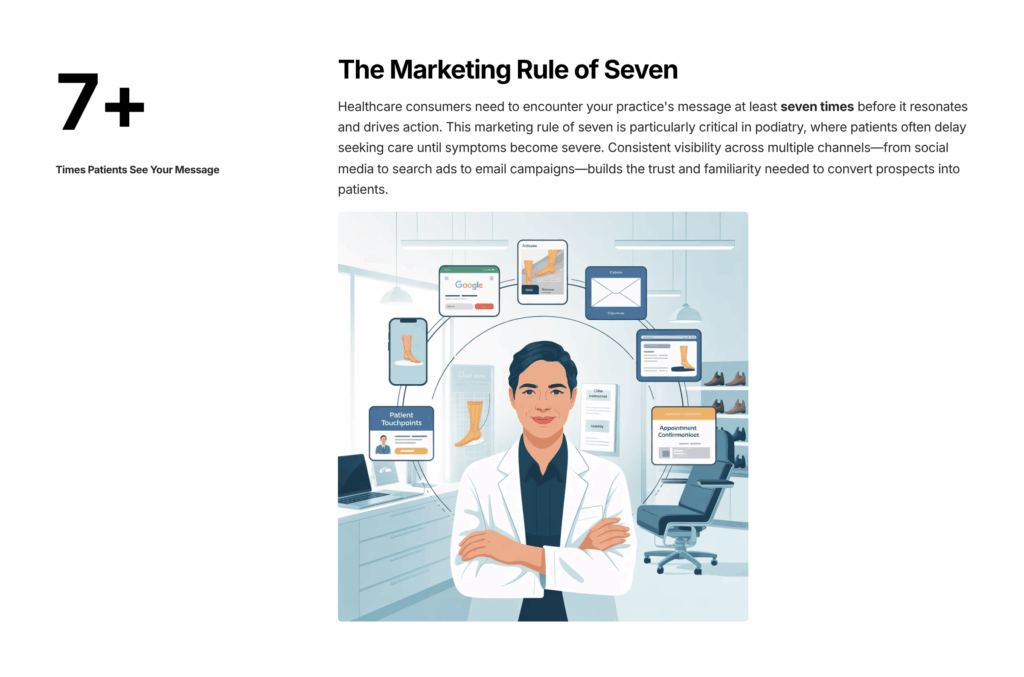
The practices that grow consistently? They say the same core messages everywhere:
- On their website
- In their Google Business Profile
- On social media
- In their office signage
- When the phone rings
Repetition isn’t boring. Repetition is how recognition gets built.
If you’re tired of your own marketing message, that’s actually a good sign. It means you’re finally saying it enough times for patients to start hearing it.
The Marketing Mistake Most Podiatrists Make
The challenge is that most podiatrists approach marketing backwards.
They create content once, post it, and move on to something new. They think variety keeps things interesting. They worry that repeating themselves makes them look unprofessional or lazy.
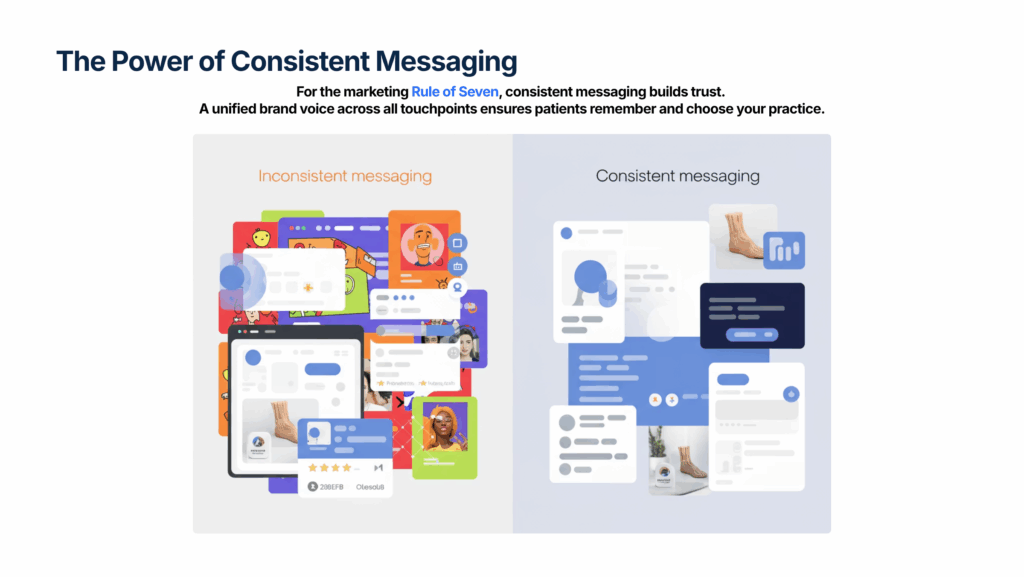
Meanwhile, their prospective patients are getting mixed messages.
Why Mixed Messages Kill Conversions
One week, the practice posts about bunion surgery. The next week, diabetic foot care. Then sports injuries. Then custom orthotics.
Each post is fine on its own, but together they create confusion rather than clarity.
When patients can’t figure out what you actually specialize in or what makes your practice different, they default to whoever has the clearest message. Often, that’s the hospital system with the six-week waitlist—not because they’re better, but because their messaging is consistent.
How Patient Behavior Has Changed
Five years ago, patients would visit multiple websites, compare practices, and spend time researching before calling.
Today? They make decisions in seconds based on:
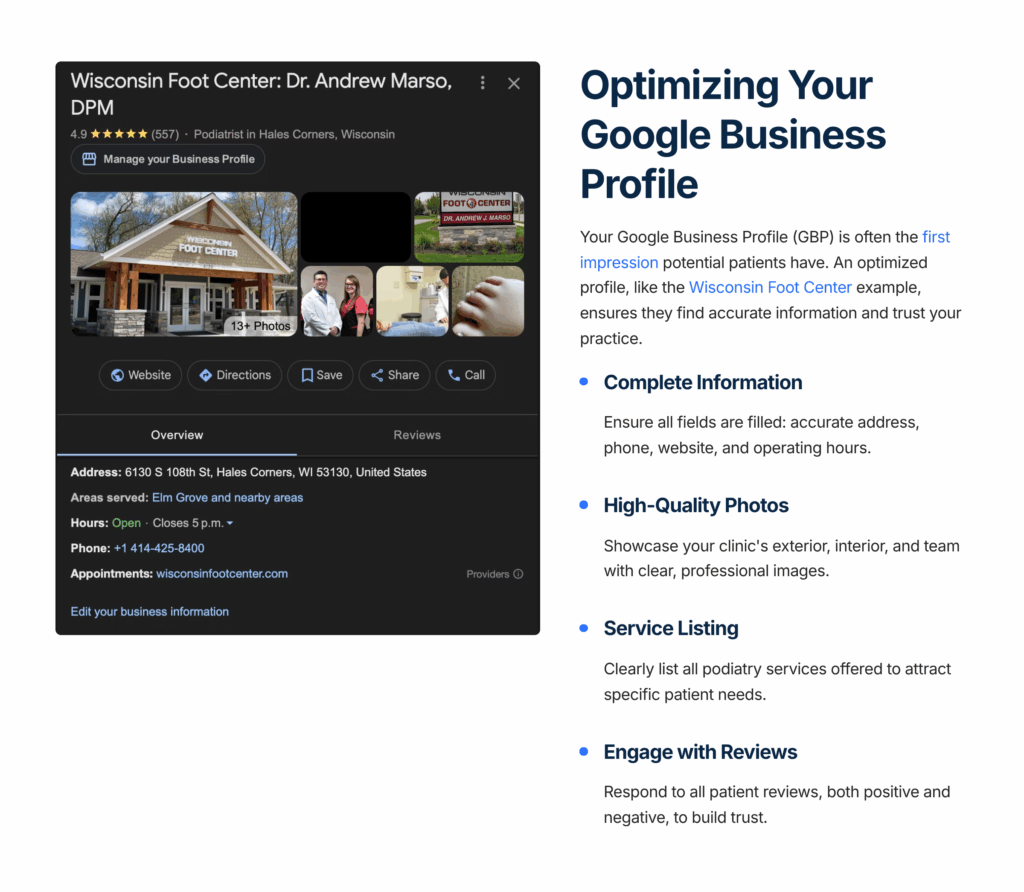
– Your Google Business Profile
– A quick glance at your website
– One social media post
If those touchpoints aren’t saying the same thing, you’ve lost them.
The problem isn’t that you’re repeating yourself too much. The problem is that you’re not repeating yourself enough.
How to Use Repetition the Right Way
Repetition Reinforces, It Doesn’t Bore
Your prospective patients aren’t reading every word, watching every video, or hearing every piece of marketing you put out there.
You might be getting sick of yourself, but patients need to hear your core messages 4, 5, 6, 7 times before they really know who you are and what you do.
Think about how you give post-op instructions to surgical patients. You don’t just tell them once and hope they remember:
– You explain it during the consult
– You give them written instructions at discharge
– You review it again at the first follow-up
– Sometimes your medical assistant repeats it too
You repeat the important information because you want patients to remember it and follow through.
Your marketing works exactly the same way.
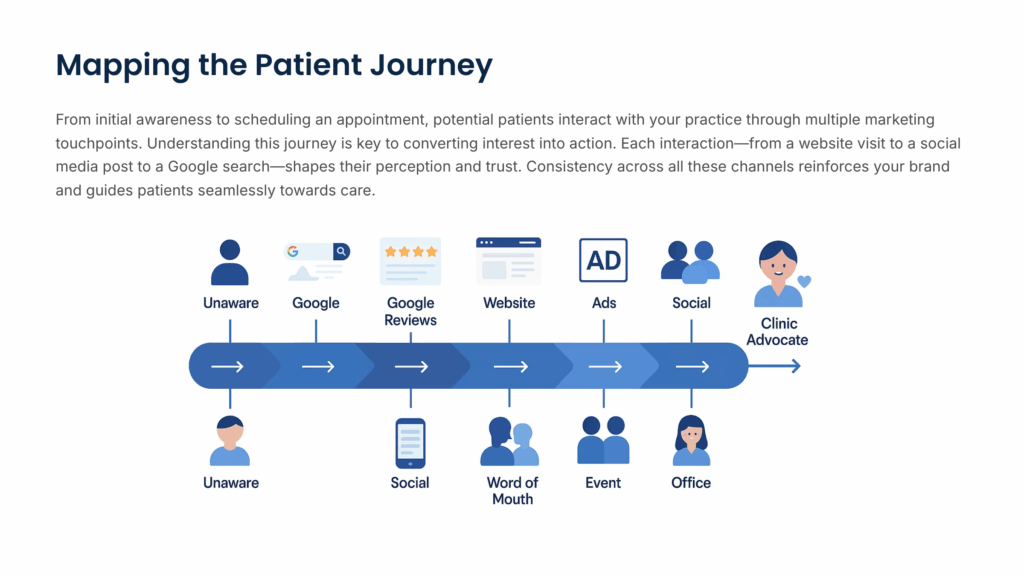
“We treat heel pain” on your website isn’t enough. Patients need to see that message in your Google Business Profile services list, in your social media posts, in your office signage, and when your front desk answers the phone.
Let Your Patients Tell You What to Say
If you’re saying the same things to patients during consults or on the phone, that’s a signal—not a flaw.
Recognize the questions that come up repeatedly:
– “Do I need orthotics?”
– “Will this bunion get worse?”
– “Can I get in today?”
– “Do you take my insurance?”
These repeated questions are your content goldmine.
Turn each one into:
– A website FAQ page
– A blog post with detailed answers
– Social media posts
– Short scripts for your front desk staff
When you build content around the questions patients are already asking, your marketing becomes more relevant and useful.
Your clinic’s messaging should be predictable—because your patients’ needs are predictable once you serve your ideal patient consistently.
Build Your Marketing Around What Already Works
Create a system to capture the things you say repeatedly that land well with patients.
Ask your team: “What do patients light up about when I explain it?”
These sound bites become your marketing language:
– Website copy
– Ad copy
– In-person messaging
– Social media captions
When patients repeat what you said to the front desk staff at checkout, or when certain phrases show up consistently in online reviews, you’re onto something.
Different patients connect with different wording, but when you find explanations that engage people and help them understand their problem and your solution, use those explanations everywhere.
Think of it as your curriculum, not chaos. You’re not trying to entertain patients—you’re educating them about how you can help.
Stop Reinventing Your Message Every Week
New patients are like students walking into your classroom. You’re not selling to them—you’re guiding them down a path.
It’s not about constantly reinventing your messaging. It’s about delivering it clearly and consistently across many touchpoints:
– Your website
– Your Google Business Profile
– Social media
– Your waiting room
– Your phone greeting
You don’t need new content every week. You need consistent content delivered confidently.
The more you talk about a specific issue, diagnosis, or treatment, the more confident you sound. And that confidence translates directly into patient trust.
This repetition helps you stand out as a leader and expert in your field.
How to Implement This in Your Practice
Now that you understand why repetition works, here’s how to put it into action this week.
Step 1: Identify Your Core Message (15 minutes)
What’s the one thing you want patients to know about your practice?
It might be:
– “We see patients same-day for urgent foot problems”
– “We specialize in getting runners back on the road”
– “We focus on diabetic foot care and prevention”
Write it down. This becomes your anchor message that you’ll repeat everywhere.
Don’t try to say everything. Pick one clear message that differentiates your practice and resonates with your ideal patient.
Step 2: Audit Where Your Message Appears (20 minutes)
Check these five touchpoints:
– Your website homepage – Is your core message in the headline?
– Your Google Business Profile – Does your business description reflect this message?
– Your social media bios – Is it mentioned there?
– Your phone greeting – Does your staff say it when answering calls?
– Your office signage – Is it visible in your waiting room?
If your message isn’t consistent across all five, you’ve found your gaps.
[INSERT IMAGE: Checklist graphic showing the 5 touchpoints with checkboxes]
Step 3: Create a Message Repository (30 minutes)
Start a simple document (Google Doc or Word file) with these sections:
– Core message (your one main differentiator)
– Three supporting points (why this matters to patients)
– Common patient questions (track these weekly)
– Phrases that work (things patients respond well to)
Share this document with your team so everyone is saying the same things.
This becomes your reference guide when writing website copy, creating social posts, or training new staff.
Step 4: Schedule Weekly Repetition (Ongoing)
Set up a simple content calendar:
– Monday: Post your core message on social media
– Wednesday: Mention it in your newsletter
– Friday: Have your front desk emphasize it on calls
You’re not creating new content every week. You’re finding different ways to say the same thing.
The message stays consistent. Only the format changes.
Total time investment: About 65 minutes to set up, then 15-20 minutes per week to maintain.
This isn’t about working harder. It’s about being more consistent with what you’re already saying.
Start Repeating Yourself More
Repetition doesn’t make you look unoriginal. It makes you look like a trusted expert.
In marketing, the enemy isn’t boredom—it’s confusion.
Next time you hear yourself saying something you’ve said a hundred times before, that’s a good thing. Say it again.
Your future patients are still learning about you and the care you provide. The more clear, consistent information you give them across every touchpoint, the more likely they are to call.
Your marketing doesn’t need to be creative. It needs to be clear and repeated.
Want Help With Your Practice’s Marketing?
Want more tips like this delivered to your inbox? Subscribe to the Podiatry Growth newsletter for weekly strategies to attract more patients and grow your practice.
Listen to the full episode on the Podiatry Marketing: Episode 204 – Why Repeating Yourself Isn’t Lazy—It’s Good Marketing.
1. Request a Free Assessment: Let’s talk about the challenges you’re facing, identify opportunities and discuss actions you can take today. This is your opportunity to better understand what digital marketing is and how it can help grow your practice.
2. Online X-Ray & Custom Growth Plan: An in-depth review and detailed plan to improve your clinic’s website and online presence.
3. Podiatry Growth Services: Get started with Podiatry Growth Services to effectively attract more patients and do more of the work you love.
4. Promote yourself to 500+ forward-thinking podiatrists: by sponsoring my newsletter.
Build A Practice
You Love